Vancouver's 2027 budget: when council votes, how property tax is set, and how to comment
The first large task for the council elected on October 17 is the City's 2027 budget. The legal steps and deadlines, what happened with the 0% tax increase for 2026, how the tax rate relates to your BC Assessment value, and how to have your say.
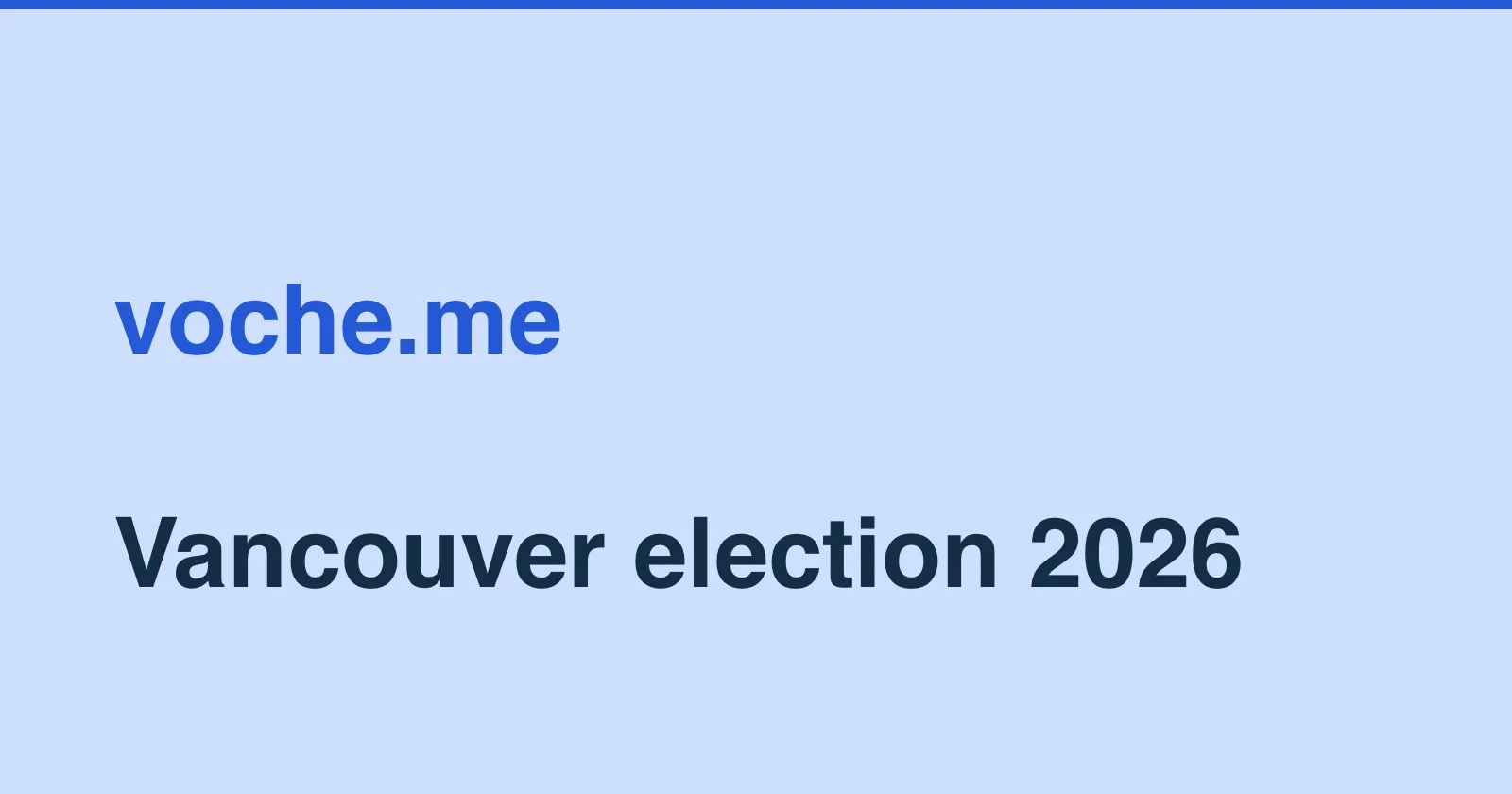
The council that takes office on November 2 has one large task in its first weeks: the City's budget for 2027. The budget decides what the City spends on police, fire, parks, libraries and streets. It also sets the property tax that pays for much of it. This guide covers the legal steps, what happened with the 2026 budget, how your tax bill is worked out, and where residents can have a say.
When the new council starts
Section 139 of the Vancouver Charter says the term of a mayor and councillors elected at a general local election begins on the first Monday after November 1, which in 2026 is Monday, November 2. From that day, the 2027 budget is the new council's decision.
What each part of city government controls is in our guide to what Vancouver City Council controls.
What the law requires
The Vancouver Charter sets the order of the steps, and one fixed date.
- The finance report. Section 219 says the Director of Finance must give Council a report with detailed estimates of the City's revenue and spending for the year, "as soon as practicable" and by April 30 at the latest. The report must also set out how much revenue is to come from each source, and how the tax is to be shared among property classes.
- The estimates. Section 372 says Council must adopt the estimates for the year after it receives the revised assessment roll, the official list of property values. The estimates show every expected source of revenue and all expected spending.
- The rating by-law. Section 373 says that once the estimates are adopted, Council must pass a rating by-law. This by-law sets the tax rate on every taxable property, high enough that the tax, added to the City's other income, pays all the debts and costs due that year.
- Spending before the vote. Section 202 lets Council approve the spending needed to keep the City running before the estimates are adopted. The limit is what was spent the year before for the same purposes, unless two-thirds of all Council members agree to more.
- A ceiling on spending. Section 200 says Council must not knowingly let total spending go above the amounts in the adopted estimates, unless the provincial cabinet consents.
How the 2026 budget was made
The City's 2026 budget page lists the sequence staff and Council followed:
- May 2025: staff prepared a budget outlook.
- June 2025: Council received the outlook.
- August 12 to September 14, 2025: an online survey was open, with pop-up events across the city.
- September to November 2025: staff wrote the proposed budget.
- November 2025: the proposed budget was published.
- Council discussed it on November 12, 13, 18 and 19, and voted on the final 2026 budget on November 25, 2025.
The City's news release of November 25, 2025 gave the result. The 2026 operating budget is $2.39 billion, with a 0% property tax increase. The City listed $120 million in savings through efficiencies and new revenue. Utility fees for solid waste, water and sewer rose by an average of 4.2%. The City put the average increase at $107 a year for a single-family home and $104 for a business property. The 2026 capital expenditure budget was set at $894 million.
What is known about 2027 so far
When we checked on September 29, 2026, the City's budget page still described the 2026 process and gave no 2027 calendar. The City's financial reports page lists a document called the 2027-2031 Budget Outlook. We could not open that file, so none of its figures appear here.
One part of the picture is already set. On July 16, 2026, Council approved the 2027-2030 Capital Plan, which the City describes as $3.5 billion in City-led investment plus $0.1 billion in amenities delivered through development. Each year's capital budget draws on that plan. Part of the plan's funding depended on 3 borrowing questions on the October 17 ballot, set out on our ballot questions page.
In 2025 the proposed budget came out in November and the vote followed later that month. The City had published no dates for 2027 when we checked. Watch the City's budget page for them.
How your tax bill is worked out
The City's page on tax notices says the City's general levy is "your property's assessed value multiplied by a tax rate set each year by Council". The rate is charged on each $1,000 of taxable value, and it is different for each property class, such as residential or business.
The value comes from BC Assessment. The City tells owners to read their BC Assessment notice "when it arrives in January", because those values are used for the main tax notice. The City sends the main notice in June, and it is due on the second business day of July.
The tax increase and the tax rate are two separate numbers. The increase describes the change in the total the City collects. The rate is then set to raise that total across all properties. In 2026, the year of the 0% increase, the City's general rate for residential property was $1.93406 per $1,000 of taxable value. In 2025 it was $1.81504.
BC Assessment explains why one owner's bill can move differently from the headline figure. It says the most important factor is how your assessed value changed relative to the average change for your property class. A home whose value rose less than the average for its class can pay a smaller share. A home whose value rose more can pay a larger one. BC Assessment adds that its examples assume stable tax rates and no shift in the budget between property classes.
The City's share of the notice
The City's release says "about half" of the total on a property tax notice goes to the City. The rest goes to provincial school taxes and to TransLink, Metro Vancouver, BC Assessment and the Municipal Finance Authority. The City's tax rates page says Council has no control over those other levies. The City includes them on its notice to save the cost of separate billing.
For a residential property in 2026, the combined rate on the City's page was $3.36394 per $1,000. Of that, $1.93406 was the City's general levy and $0.98001 was the provincial school tax.
How to have your say
- Budget survey. For the 2026 budget, the City ran its survey on its Shape Your City site from August 12 to September 14, 2025. A 2027 survey would appear on the same site.
- Speak at Council. The City says you can sign up to speak, in person or by phone, on agenda items that accept speakers. Agendas are typically posted 1 week before a meeting, and sign-up closes at 5pm on the day before.
- Write to Council. You can send written comments on any agenda item, including one that takes no speakers. The City says Council receives all comments sent through its form.
The steps for speaking are in our guide on how to speak at Vancouver City Council.
Dates to know
- November 2, 2026: the new council's term begins.
- January 2027: BC Assessment notices arrive, with the values used for 2027 taxes.
- By April 30, 2027: the Director of Finance's report on 2027 revenue and spending, under section 219.
- June 2027: the main property tax notice is sent.
The City of Vancouver and the Vancouver Charter are the authorities on the budget and on property tax. If anything here disagrees with vancouver.ca, the City's page is correct.
Questions this story answers
When does Vancouver's new council start work on the 2027 budget?
Section 139 of the Vancouver Charter says the term of a mayor and councillors elected at a general local election begins on the first Monday after November 1. In 2026 that is Monday, November 2. The 2027 budget is decided by the council that takes office on that date.
What property tax increase did Vancouver approve for 2026?
The City of Vancouver's news release of November 25, 2025 says Council approved the 2026 budget with a 0% property tax increase. The 2026 operating budget is $2.39 billion, and the City listed $120 million in savings through efficiencies and new revenue.
Did Vancouver utility fees go up in 2026?
Yes. The City of Vancouver's November 25, 2025 release says utility fees for solid waste, water and sewer rose by an average of 4.2% in 2026. The City gave the average increase as $107 a year for a single-family home and $104 for a business property.
What is the legal deadline for Vancouver's budget report?
Section 219 of the Vancouver Charter says the Director of Finance must give Council a detailed report of the year's expected revenue and spending as soon as practicable, and by April 30 at the latest. Council then adopts the estimates and passes the annual rating by-law.
Can Vancouver spend money before the budget is adopted?
Yes, within a limit. Section 202 of the Vancouver Charter lets Council approve the spending needed to run the City before the estimates are adopted, but no more than was spent the year before for the same purposes, unless two-thirds of all Council members agree.
How is my Vancouver property tax calculated?
The City of Vancouver says the City's general levy is your property's assessed value multiplied by a tax rate that Council sets each year. The rate is charged on each $1,000 of taxable value. BC Assessment supplies the value, on the notice owners receive in January.
If my BC Assessment went up, will my property tax go up?
It depends on the average. BC Assessment says the most important factor is how your value changed compared with the average change for your property class in your municipality. A value that rose less than the average can lead to a lower share of the tax, assuming stable rates.
How much of my Vancouver tax notice goes to the City?
The City of Vancouver says "about half" of the total on a property tax notice goes to the City. The rest goes to provincial school taxes and to levies from TransLink, Metro Vancouver, BC Assessment and the Municipal Finance Authority, which the City collects on the same notice.
How can I comment on the Vancouver budget?
For the 2026 budget, the City of Vancouver ran an online survey and pop-up events from August 12 to September 14, 2025. Residents can also send written comments on any Council agenda item, or sign up to speak on items that accept speakers, until 5pm the day before.
Sources
The pages this story draws on. Open one to check a claim yourself.
- City of Vancouver, 2026 Budget (process timeline)vancouver.ca
- City of Vancouver, Council approves 2026 Budget with 0% property tax increase (November 25, 2025)vancouver.ca
- City of Vancouver, Property tax ratesvancouver.ca
- City of Vancouver, Residential property tax ratesvancouver.ca
- BC Assessment, Property assessments and property taxesinfo.bcassessment.ca
- Vancouver Charter: sections 139, 200, 202, 219, 372 and 373bclaws.gov.bc.ca
Found an error? Tell the editors with the corrections form. A correction is noted on the story it changes. Read our standards.
Topics
More from voche.me