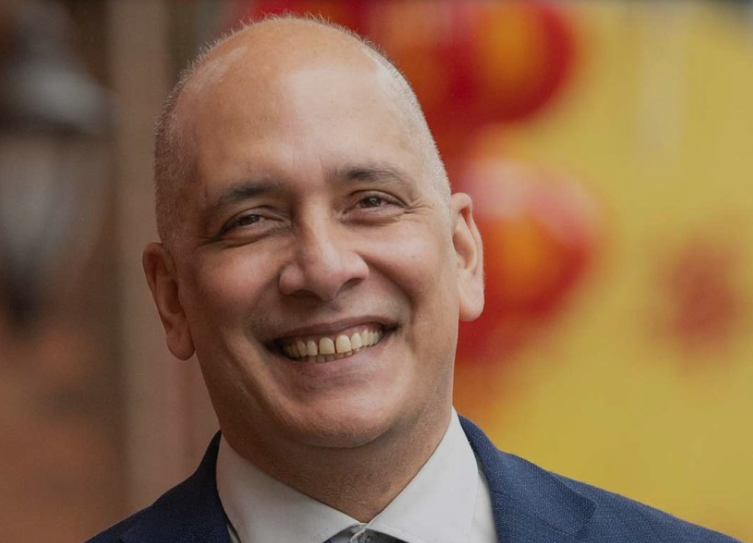
Pete Fry: from Strathcona print shop to the progressive candidate for mayor
A sourced profile of the Green Party’s mayoral candidate: his family and design career, three losing campaigns before two wins, eight years in opposition, the criticism of his record, and what he promises.
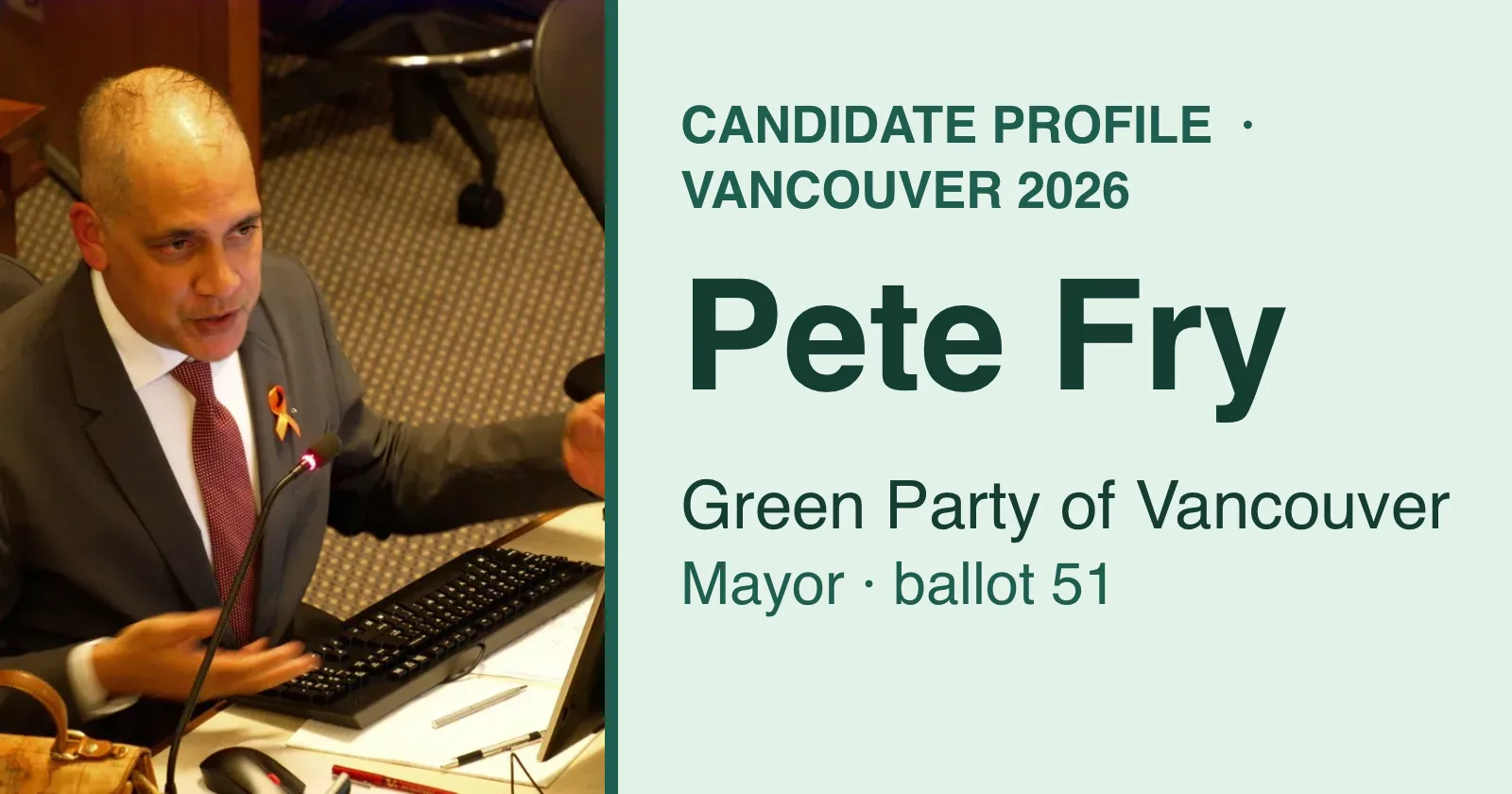
Pete Fry is number 51 on the mayoral ballot, running for the Green Party of Vancouver. He has been a city councillor since 2018. In September 2026 the two other progressive candidates, COPE’s Stephanie Allen and OneCity’s William Azaroff, withdrew, which left him as the only mayoral candidate from the three parties, and the poll that followed put him ahead of Mayor Ken Sim. This profile covers his life, his record, the criticism he faces and his platform, with a source for each claim listed at the end. His full research page is at voche.me/candidates/pete-fry.
Dublin, Kingsway, then Hastings Street
Fry was born in Dublin, Ireland, in 1969 to parents who were both doctors. The family moved to Vancouver when he was a small child. His mother, Hedy Fry, has represented Vancouver Centre in Parliament since 1993 and is the longest-serving woman in the House of Commons. He was 25 when she was first elected.
He has lived in Strathcona, beside the Downtown Eastside, for close to 30 years. In the 1980s he lived in a shared house at Princess and Cordova and ran a print shop on East Hastings Street under the name Digiboy, designing magazine covers, concert posters and album covers. He later moved into corporate design work and ran a graphics and communications agency.
He has told two interviewers what pulled him into civic life: a friend was hit by a car on Prior Street and died, and he began working on traffic safety and planning in his neighbourhood. His first City role was the Dog Strategy Task Force in the mid-2000s. In the early 2010s he was a community representative on the Downtown Eastside Local Area Plan and chaired the Strathcona Residents’ Association.
Three losses before a win
Fry ran for Council with the Greens in 2014 and did not win. In 2016 he ran for the BC Greens in the Vancouver-Mount Pleasant provincial by-election and placed second, with 27.07% against the NDP’s 60.14%. In the 2017 Council by-election he placed second again, behind the NPA’s Hector Bremner.
In 2018 he won a seat with 61,806 votes, the second-highest total of any council candidate. In 2022 he was re-elected with 37,270 votes, taking the tenth and final seat. He represented Vancouver at the Union of BC Municipalities for three years.
Eight years in opposition
Fry has spent his Council career outside the governing party: first opposite Kennedy Stewart’s independent mayoralty, then, from late 2022, opposite Ken Sim’s ABC majority. He has been a steady critic of that majority on three matters: the attempt to abolish the elected Park Board, the pause on new supportive housing, and ABC’s attempt to suspend integrity commissioner investigations.
His own motions show what he tried to do. In February 2025 he asked staff to review the City’s exposure to foreign suppliers and find ways to buy locally and within Canada. In July 2026 he moved to restore a renters’ office at City Hall; his party reports Council rejected it on July 28.
The criticism
Fry’s record draws criticism from two directions.
From the housing side. Mo Amir, writing in The Tyee on September 22, argued that Fry has not yet said clearly what he stands for as a mayoral candidate. He wrote that Fry has voted with ABC 89% of the time on housing, so his housing position is close to the mayor’s, and that on public safety and affordability he has offered “broad principles but few concrete ideas.”
From ABC. ABC’s campaign advertising describes Fry as soft on crime and hostile to police, based on his police funding votes. The Tyee’s September 18 review of those ads found they blur the difference between the launch of a police task force and a later funding vote. Fry called the ads misleading; ABC councillor Peter Meiszner said they describe his voting record.
On his party’s strength. The Greens raised less than $69,000 in 2025, against $327,000 for OneCity and $606,000 for ABC, according to The Tyee. When William Azaroff withdrew on September 8 he questioned in public whether the Greens had the fundraising, volunteers and door-knocking to win.
None of these is an allegation of wrongdoing. They are disagreements about votes and about whether his campaign can win.
The September shift
Stephanie Allen left the race on September 2 and William Azaroff on September 8. Daily Hive reported that Azaroff endorsed Fry. The Tyee reported that neither Azaroff nor Allen would explicitly endorse him, citing uncertainty about Elections BC’s rules on endorsing another party’s candidate. The Justason Market Intelligence poll taken from August 31 to September 11 put him at 45% of decided voters to Sim’s 30%. Interviews taken after September 8 put him at 59%. The full numbers, and the reasons to read them with care, are on the polls page.
What the Greens promise for 2026
- Pre-approved housing designs, including prefabricated homes, and simpler permits for apartments, townhomes and infill.
- Retrofit partnerships to keep existing affordable homes where that is feasible, and support for wood construction.
- A “Buy Vancouver, Build Canada” purchasing policy that prefers local and Canadian suppliers and restores community benefit agreements on City projects.
- Reversal of the pause on new supportive housing.
- Keeping the elected Park Board.
- Dependable City services, which his January announcement named alongside safety, the local economy and accountable leadership.
What is still unknown
The Greens have not published a funded timetable for the housing proposals, the service standards and tax assumptions of a first budget, or numeric targets for housing delivery and community safety. His research page lists those as open questions; the campaign has not published answers. The 89% voting-alignment figure comes from an opinion column; voche.me has not recomputed it from Council minutes.
Image: Kent Lins, CC BY 2.0, 2018, cropped and composed with text by voche.me.
Questions this story answers
What is Pete Fry’s ballot number and party in the 2026 Vancouver mayoral race?
Pete Fry is number 51 on the mayoral ballot for the October 17, 2026 Vancouver election, running for the Green Party of Vancouver. He has been a city councillor since 2018, winning 61,806 votes that year, the second-highest total of any council candidate, and 37,270 votes in 2022, when he took the tenth and final seat. He represented Vancouver at the Union of BC Municipalities for three years.
Did Stephanie Allen and William Azaroff endorse Pete Fry?
COPE’s Stephanie Allen left the mayoral race on September 2, 2026 and OneCity’s William Azaroff left on September 8, 2026, leaving Pete Fry as the single progressive candidate against Mayor Ken Sim. Daily Hive reported that Azaroff endorsed Fry. The Tyee reported that neither Azaroff nor Allen would explicitly endorse him, citing uncertainty about Elections BC’s rules. Azaroff questioned in public whether the Greens had the fundraising, volunteers and door-knocking to win. The Greens raised less than $69,000 in 2025, against $327,000 for OneCity and $606,000 for ABC, according to The Tyee.
Is Pete Fry ahead of Ken Sim in the polls?
Pete Fry led Ken Sim in the Justason Market Intelligence poll taken from August 31 to September 11, 2026, with 45% of decided voters to Sim’s 30%. Interviews taken after September 8, the day the last of the two other progressive candidates withdrew, put Fry at 59%. The full numbers, and the reasons to read them with care, are charted on the voche.me polls page.
What is Pete Fry’s background before Council?
Pete Fry was born in Dublin, Ireland, in 1969 to parents who were both doctors, and moved to Vancouver as a small child. His mother, Hedy Fry, has represented Vancouver Centre in Parliament since 1993. He has lived in Strathcona for close to 30 years, ran a print shop on East Hastings Street under the name Digiboy in the 1980s, and later ran a graphics and communications agency. He chaired the Strathcona Residents’ Association and was a community representative on the Downtown Eastside Local Area Plan in the early 2010s.
How many elections did Pete Fry lose before winning a Council seat?
Pete Fry lost three elections before winning one. He ran for Council with the Greens in 2014 and did not win. In the 2016 Vancouver-Mount Pleasant provincial by-election he placed second for the BC Greens with 27.07% against the NDP’s 60.14%. In the 2017 Council by-election he placed second again, behind the NPA’s Hector Bremner. He won a Council seat in 2018 and was re-elected in 2022.
What criticism does Pete Fry face as a mayoral candidate?
Criticism of Pete Fry comes from two directions. Mo Amir, writing in The Tyee on September 22, 2026, argued that Fry has voted with ABC 89% of the time on housing and has offered “broad principles but few concrete ideas” on public safety and affordability. ABC Vancouver’s advertising describes him as soft on crime based on his police funding votes; The Tyee’s September 18 review found those ads blur the difference between the launch of a police task force and a later funding vote. These are disagreements about votes and about whether his campaign can win.
What has Pete Fry opposed on Council under Ken Sim?
Pete Fry has spent his Council career outside the governing party and has been a steady critic of Ken Sim’s ABC majority on three matters: the attempt to abolish the elected Park Board, the pause on new supportive housing, and ABC’s attempt to suspend integrity commissioner investigations. In February 2025 he asked staff to review the City’s exposure to foreign suppliers, and in July 2026 he moved to restore a renters’ office at City Hall, which his party reports Council rejected on July 28, 2026.
What does the Green Party of Vancouver promise if Pete Fry becomes mayor?
The Green Party of Vancouver’s 2026 platform under Pete Fry promises pre-approved housing designs including prefabricated homes, simpler permits for apartments, townhomes and infill, a “Buy Vancouver, Build Canada” purchasing policy that prefers local and Canadian suppliers, reversal of the pause on new supportive housing, and keeping the elected Park Board. The Greens have not published a funded timetable for the housing proposals or numeric targets for housing delivery and community safety.
Sources
The pages this story draws on. Open one to check a claim yourself.
- Daily Hive, William Azaroff makes the Vancouver mayoral announcement many expected, endorses Pete Fry, September 8, 2026dailyhive.com
- The Tyee, And Then There Was One Progressive Running for Vancouver Mayor, September 9, 2026thetyee.ca
- Pete Fry, Wikipedia, with its cited referencesen.wikipedia.org
- The Tyee, Vancouver Greens’ Pete Fry is running for mayor, April 15, 2026thetyee.ca
- Vancity Lookout interview, March 13, 2026vancitylookout.com
- The Tyee opinion, The problem with Pete Fry’s mayoral campaign, September 22, 2026thetyee.ca
- The Tyee, Ken Sim, Pete Fry and the crime rate in campaign ads, September 18, 2026thetyee.ca
- Justason Market Intelligence poll release, September 16, 2026justasonmi.com
- Vancouver Greens, Pete Fry announces candidacy for mayor, January 30, 2026vangreens.ca
- Vancouver Greens housing plan, September 2026vangreens.ca
- Vancouver Greens, Buy Vancouver, Build Canada economic strategyvangreens.ca
- Council motion on a renters’ office, July 15, 2026council.vancouver.ca
- 2026 Vancouver municipal election, Wikipediaen.wikipedia.org
- City of Vancouver, 2026 mayoral candidatesvancouver.ca
Found an error? Tell the editors with the corrections form. A correction is noted on the story it changes. Read our standards.