How to mark your Vancouver ballot: 27 seats, four races and one rule that cancels votes
You can vote for 1 mayor, 10 councillors, 7 park commissioners and 9 school trustees on October 17. Here is how the ballot is laid out, what the counting machine accepts, and the one mistake that throws out your votes in a race.
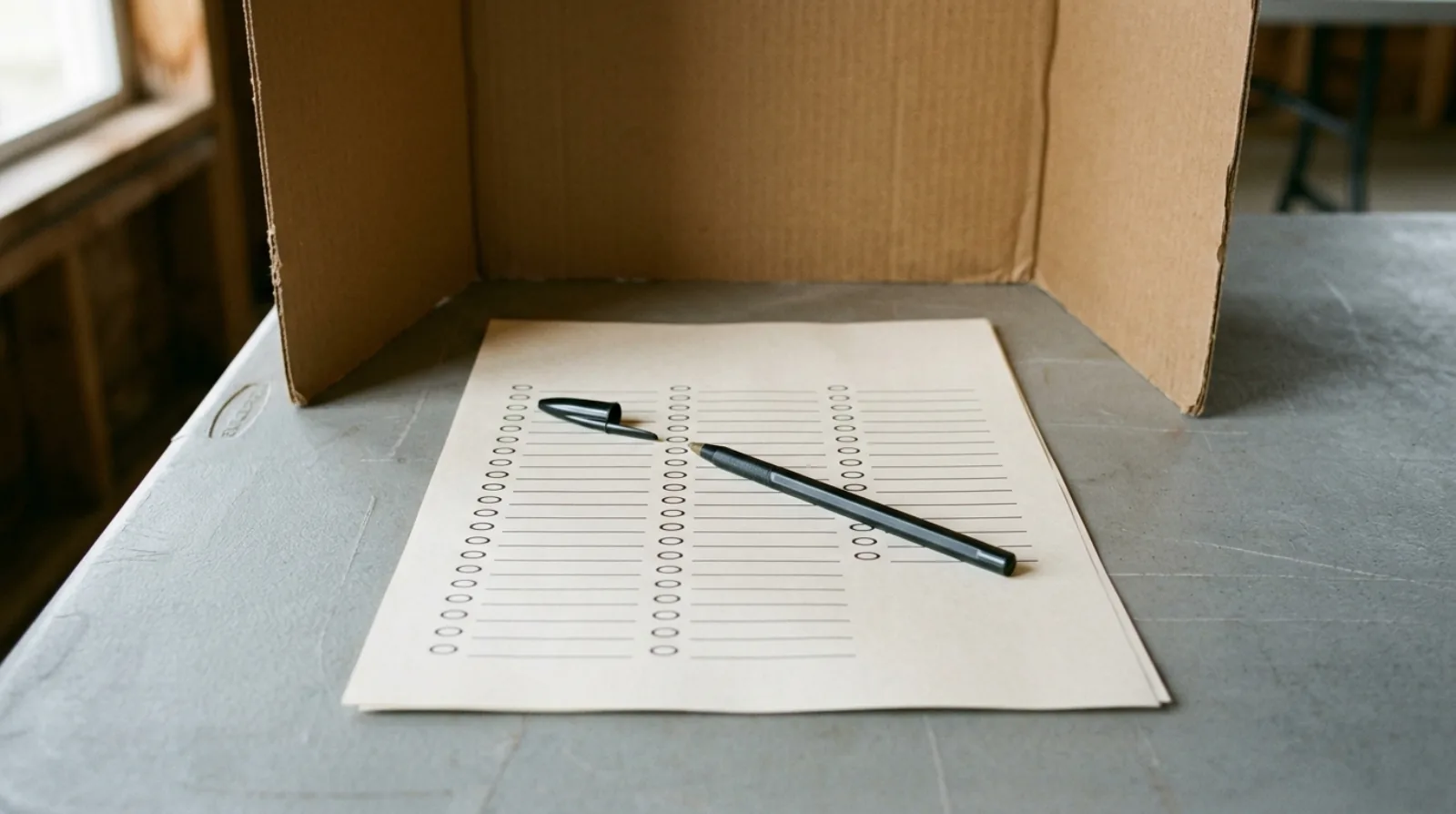
Vancouver elects 27 people on October 17, 2026, and every one of them is chosen on a single sheet of paper. This guide explains how that sheet is laid out, what the counting machine accepts, and the one mistake that cancels your votes in a race.
Four races, 27 seats
The ballot has four races. You can vote for:
- 1 mayor
- 10 city councillors
- 7 Park Board commissioners
- 9 school trustees
Vancouver has no wards. Every seat is elected at large, so a voter in Kerrisdale and a voter in Strathcona choose from the same list of names for each race. The candidates with the most votes win, up to the number of seats in that race. Nobody needs a majority.
The lists are long. Daily Hive's September 22 list of the ballot order counts 8 names for mayor, 56 for council and 35 for Park Board. You can read every candidate's record on our candidates page and compare the mayoral field side by side on the comparison page.
Names are in random order
A name near the top of the ballot got there by chance. The City of Vancouver set the order by a random draw on September 18, 2026. Section 79 of the Vancouver Charter lets Council choose a draw by lot instead of alphabetical order, and the draw result is final.
The City's voter's guide says candidates are listed in numeric order based on that draw. Each candidate has a number beside their name, and the City suggests writing down the numbers of the people you want before you go, so you can find them quickly in a list of 56.
How to make a mark that counts
The City of Vancouver counts ballots with tabulating machines that read the marks on the paper, according to its open data notes. Follow the marking instructions printed on the ballot exactly. If anything is unclear, ask: section 91(2) of the Vancouver Charter says an election official must explain how to mark the ballot when a voter asks.
Section 101(1) of the Charter says a mark that clearly shows which candidate you intend to vote for is accepted as a valid vote. A mark in the place the instructions show is the one the machine is built to read, so it is the safest choice.
For 2026 the City lists 5 assistive ballot marking devices among the changes meant to make voting more accessible.
The rule that cancels a race
Section 101(4)(e) of the Charter says a ballot is rejected for a race if it has more marks for that race than there are seats.
In practice:
- Mark 2 names for mayor, and your mayoral vote counts for nobody.
- Mark 11 names for council, and all 11 council votes are rejected.
- Mark 8 names for Park Board, and none of your Park Board votes count.
The damage stops at that race. Section 101(3) says that when one ballot carries several races, each race is treated as a separate ballot. Your votes in the other three races are still counted.
Marking fewer names than the limit is allowed. You can vote for 4 councillors, or 1, or none. Each mark you make is one full vote for that person. Some voters mark fewer names on purpose, because a vote for a candidate they like less can help that candidate pass the one they prefer.
Two ways to lose every vote on the ballot
Section 101(4) lists two cases where the whole ballot is rejected, in every race:
- A blank ballot. A ballot with no valid marks on it at all counts for nothing.
- A ballot that identifies you. A ballot marked in a way that could reasonably identify the voter is rejected in total. Do not sign it, write your initials, or add a note.
If you make a mistake
Stop before the ballot goes into the machine. Section 90 of the Charter says a voter who spoils a ballot by accident can give it to the presiding election official and get a new one. The official marks the first ballot as spoiled and keeps it apart from the count.
Once a ballot is in the box, it cannot be taken back.
If you need help
Section 93 of the Charter lets a voter who cannot mark a ballot because of a physical disability, or difficulty reading or writing, be helped by an election official or by a person they bring. A helper who is not an election official signs a written statement and makes a solemn declaration before the presiding election official. An election official must also explain how to mark the ballot if you ask (section 91(2)).
To find a voting place with a machine that has accessible voting features, filter the list on our where to vote page.
The questions that come with the ballot
Candidates are only part of what you decide. The same voting visit includes three capital plan borrowing questions, worth $790 million together, and two public safety plebiscite questions on a separate ballot. The wording of all five is on our ballot questions page.
Why a long ballot matters
Vancouver has seen what a long ballot can do. The City's own notes on its ballot data say the 2018 election had 158 candidates. The ballot was longer than usual and caused paper jams in the counting machines at some voting places. The City then recounted 57,000 ballots from 50 voting places, a figure it gives as approximate. The recount did not change who won.
This year's list is shorter, but it is still long. Five minutes with a list of numbers before you leave home will make the ballot easier to fill in.
Before you go
- Decide how many names you want in each race, up to the limit.
- Write down each candidate's ballot number.
- Check the four advance voting days and all voting places on our where to vote page, or apply to vote by mail.
The City of Vancouver is the authority on how to vote. If anything here disagrees with vancouver.ca, the City's page is correct.
Questions this story answers
How many candidates can I vote for on the 2026 Vancouver ballot?
You can vote for up to 27 people on October 17, 2026: 1 mayor, 10 city councillors, 7 Park Board commissioners and 9 school trustees. All of these seats are elected at large, so every voter in the city chooses from the same list of candidates for each race.
Do I have to vote for 10 councillors?
You can vote for any number of council candidates from 0 to 10. Each mark you make counts as one full vote for that candidate, however many you mark. If you leave a race blank, your votes in the other races on the ballot still count.
What happens if I vote for too many candidates in one race?
Section 101(4)(e) of the Vancouver Charter says a ballot is rejected for a race when it has more marks for that race than there are seats. If you mark 11 council candidates, none of your council votes count. Your votes in the mayor, Park Board and school board races are still counted, because the Charter treats each race on a combined ballot as a separate ballot.
How are Vancouver ballots counted?
The City of Vancouver counts ballots with tabulating machines that read the marks on each ballot. Follow the marking instructions printed on the ballot, and ask an election official if anything is unclear. Section 91(2) of the Vancouver Charter says the official must explain the method when asked.
Can I get a new ballot if I make a mistake?
Yes. Section 90 of the Vancouver Charter says a voter who spoils a ballot by accident, before it goes into the ballot box, can hand it to the presiding election official and get a replacement. The official marks the first ballot as spoiled and keeps it apart.
Can I write my name or a message on my ballot?
You should not. Under section 101(4)(c) of the Vancouver Charter, a ballot marked in a way that could reasonably identify the voter is rejected in total, which means every vote on it is lost. Make only the marks the instructions ask for.
How was the order of names on the Vancouver ballot decided?
The City of Vancouver set the order by a random draw on September 18, 2026. Section 79 of the Vancouver Charter allows Council to choose a draw by lot instead of alphabetical order, so a name near the top of the list got there by chance.
Can someone help me mark my ballot?
Yes. Section 93 of the Vancouver Charter lets a voter who cannot mark a ballot because of a physical disability, or difficulty reading or writing, be helped by an election official or by a person they bring. A helper who is not an election official must sign a statement and make a solemn declaration first.
Are the plebiscite questions on the same ballot as the candidates?
The two public safety plebiscite questions are printed on their own ballot, separate from the candidates and from the three capital plan borrowing questions. The voche.me ballot questions page quotes the wording of each question.
Sources
The pages this story draws on. Open one to check a claim yourself.
- Vancouver Charter, Part I: sections 79, 90, 91, 93 and 101bclaws.gov.bc.ca
- City of Vancouver, Guide to voting (2026 voter's guide)vancouver.ca
- City of Vancouver, Candidate list final: ballot order available for the 2026 Vancouver Electionvancouver.ca
- City of Vancouver Open Data, Anonymous ballot marking (dataset notes on the 2018 election)opendata.vancouver.ca
- Daily Hive, Vancouver's 2026 civic election candidate list is set: all names in ballot orderdailyhive.com
Found an error? Tell the editors with the corrections form. A correction is noted on the story it changes. Read our standards.
Topics
More from voche.me


Vancouver Liberals release 148-point platform: bike lanes, tax cap, 50-metre pool