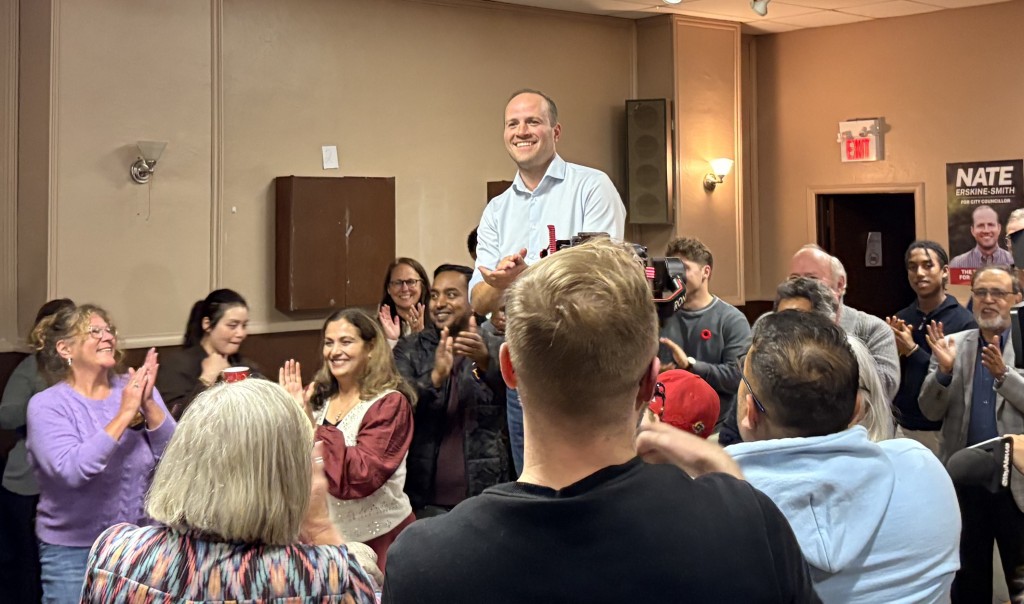
Toronto's 2026 voter turnout reached its highest level in more than a decade
989,990 Torontonians cast a ballot on October 26, giving the city a 46 per cent turnout rate, 10 points above the provincial average and the highest since John Tory's first election in 2014.
Long read. The subject the most local outlets covered that day, with the public record behind it. Every outlet and record is linked under the story. Read the original report on globalnews.ca.

Toronto drew 989,990 voters to the polls on October 26, 2026. That is the city's highest turnout in 12 years, and 10 points above the Ontario provincial average.
The Association of Municipalities of Ontario collected unofficial results showing 46 per cent of eligible Toronto voters cast a ballot, according to Global News Toronto. The provincial average across municipalities was about 36 per cent.
Mayor Olivia Chow won a second term with 532,201 votes. The Trillium reported that her campaign said the total sets a record for any mayoral candidate in any Toronto municipal election in Canadian history. Brad Bradford received 404,013 votes.
What drove turnout higher
Political scientists who spoke to Global News Toronto pointed to several reasons for the gap between Toronto and the rest of Ontario.
The closest contest was the top driver. Cristine de Clercy, a political scientist at Trent University, told Global News that the tight race between Chow and Bradford brought out voters who would have stayed home if the result looked settled.
"It attracted attention, and it seems to me an important effect that that contest, which seemed to become closer as the campaign wore on, certainly had a large effect on turnout," de Clercy said.
Polls putting Bradford ahead of Chow in the final week increased the sense that every vote mattered. Community organizations worked through the final days of the campaign to register and turn out voters they might not have reached in quieter years.
Myer Siemiatycki, professor emeritus of politics and public administration at Toronto Metropolitan University, told Global News that the competitive race alone could not explain why Toronto outpaced other Ontario cities with close contests.
"I think the difference in Toronto is number one, there's a much stronger political culture of participation in the city," Siemiatycki said. He added that Toronto's dense and varied media coverage kept the election visible to more people for longer.
How 2026 compares to recent elections
Toronto's pattern since 2014 shows how much a contested race can move participation.
In 2014, 54.7 per cent of eligible voters cast ballots when John Tory first won the mayor's seat, according to CityNews Toronto. In 2018, when Tory ran for re-election in a less competitive race, turnout fell to 40.9 per cent. In 2022, when Tory was widely expected to win again, it dropped to a record low of 29.7 per cent.
The 2026 election reversed that slide. With 2,143,771 eligible voters, the 989,990 ballots cast represent a turnout of about 46 per cent.
Chow herself had 532,201 certified votes in 2026. In the 2023 byelection, she had received 269,372. The Trillium noted she is also the first woman to win a second term as mayor of Toronto.
How Toronto compared to other Ontario cities
The Association of Municipalities of Ontario's data, which Global News Toronto reported, showed turnout varied widely across Ontario.
In Mississauga, where a three-way mayoral race ended with all three leading candidates losing vote share, 34 per cent of eligible voters cast ballots. That represents a 12-point increase from 2022 but is still 12 points below Toronto's rate.
London, Ontario came in at 31 per cent. Chatham-Kent and Greater Sudbury were both at 41 per cent. Kitchener had the lowest rate of any large municipality at 22 per cent, less than half of Toronto's.
Siemiatycki told Global News that smaller municipalities without the same media density face a structural disadvantage in reaching voters.
"Whereas in Toronto, of course, there's such a rich and multifaceted, diverse media ecosystem, there's just a lot more information, a lot of reminders and focus on the municipal election race," he said.
Even so, he added, a 46 per cent rate is still too low. "Is still too low and is a problem and we need to think about how to increase it," he told Global News.
What comes next
The City Clerk certified the 2026 results on October 30. Under section 6 (1) of Ontario's Municipal Elections Act, 1996, the new four-year term starts on November 15, 2026. The first meeting of the new City Council is on November 18, set by section 27-5.1 of the Toronto Municipal Code. That meeting opens the term during which the 989,990 people who voted will see whether the mayor and councillors deliver on their campaign commitments.
Mayor Chow used her October 26 victory speech to repeat her main second-term commitments: improving TTC affordability, building more affordable rental housing, protecting renters and investing in public safety, according to CityNews Toronto. She has committed to capping TTC fares after 10 paid rides per week and to freezing fares for a fourth consecutive year.
Residents who want to track whether she delivers on those commitments can follow the tracker at /on/toronto-2026/tracker. The full list of ward results is at /on/toronto-2026/results.
Questions this story answers
How many people voted in Toronto's 2026 municipal election?
The City of Toronto reported 989,990 ballots cast in the October 26 municipal election, according to Global News Toronto. With 2,143,771 eligible voters, that represents a turnout rate of 46 per cent, according to data from the Association of Municipalities of Ontario.
Is 46 per cent turnout high for Toronto?
It is the highest since 2014, when 54.7 per cent voted in the race that elected John Tory as mayor, according to CityNews Toronto. Toronto recorded 40.9 per cent turnout in 2018 and a record low of 29.7 per cent in 2022, according to CityNews. The 46 per cent figure is also 10 points above the provincial average of 36 per cent, based on Association of Municipalities of Ontario data reported by Global News.
How did Olivia Chow's vote total compare to her 2023 result?
Chow received 532,201 votes in the 2026 election, compared to 269,372 in the 2023 byelection, according to The Trillium. That is nearly double her 2023 total. The Trillium reported that her campaign said this is a record for any mayoral candidate in any Toronto municipal election in Canadian history.
How did Toronto's turnout compare to other Ontario cities?
The Ontario average was about 36 per cent, according to Association of Municipalities of Ontario data reported by Global News Toronto. Mississauga, which also had a competitive three-way mayoral race, came in at 34 per cent. London, Ontario had 31 per cent turnout. Global News reported that Chatham-Kent and Greater Sudbury were at 41 per cent, while Kitchener had the lowest at 22 per cent.
What did political scientists say drove the high turnout in Toronto?
Cristine de Clercy, a political scientist at Trent University, told Global News that the close contest between Chow and Bradford was the top driver, because voters and volunteers felt their efforts could make a difference. Myer Siemiatycki, professor emeritus at Toronto Metropolitan University, told Global News that Toronto also has a stronger political culture and denser media ecosystem than other Ontario cities, both of which push participation higher.
When does the new Toronto City Council start?
Section 6 (1) of Ontario's Municipal Elections Act, 1996 starts the four-year term on November 15, 2026. Section 27-5.1 of the Toronto Municipal Code sets the first meeting of the new City Council for the first Wednesday after that, which is November 18, 2026. You can follow Mayor Chow's commitments on the tracker at /on/toronto-2026/tracker.
What has Mayor Chow promised for her second term?
Chow used her victory speech on October 26 to repeat promises to improve TTC affordability, build more affordable housing, protect renters and invest in public safety, according to CityNews Toronto. Her tracker on this site at /on/toronto-2026/tracker lists her specific commitments, including a weekly TTC fare cap of 10 paid rides and a fourth consecutive year of frozen fares.
Who was elected besides Mayor Chow?
Toronto elected one councillor in each of 25 City wards and school trustees for four boards on October 26. The City Clerk certified the results on October 30. You can see the full list of ward results at /on/toronto-2026/results.
Sources
The pages this story draws on. Open one to check a claim yourself.
- Global News Toronto: Why Toronto's municipal election turnout beat the provincial averageglobalnews.ca
- The Trillium: Olivia Chow sets record with most votes in Toronto historythetrillium.ca
- CityNews Toronto: Toronto voter turnout climbs to highest level in more than a decadetoronto.citynews.ca
- City of Toronto: Toronto City Clerk certifies 2026 Toronto municipal election resultstoronto.ca
Found an error? Tell the editors with the corrections form. A correction is noted on the story it changes. Read our standards.