Bradford closes gap with Chow to 3.5 points among decided voters, Nanos poll shows
A Nanos poll of 757 Toronto residents taken October 8 to 10 found Olivia Chow at 51 per cent and Brad Bradford at 47 per cent among decided voters, a narrower gap than the previous Nanos survey.
Reported. A news outlet found this. voche.me names the outlet and links its report. Read the original report on ctvnews.ca.
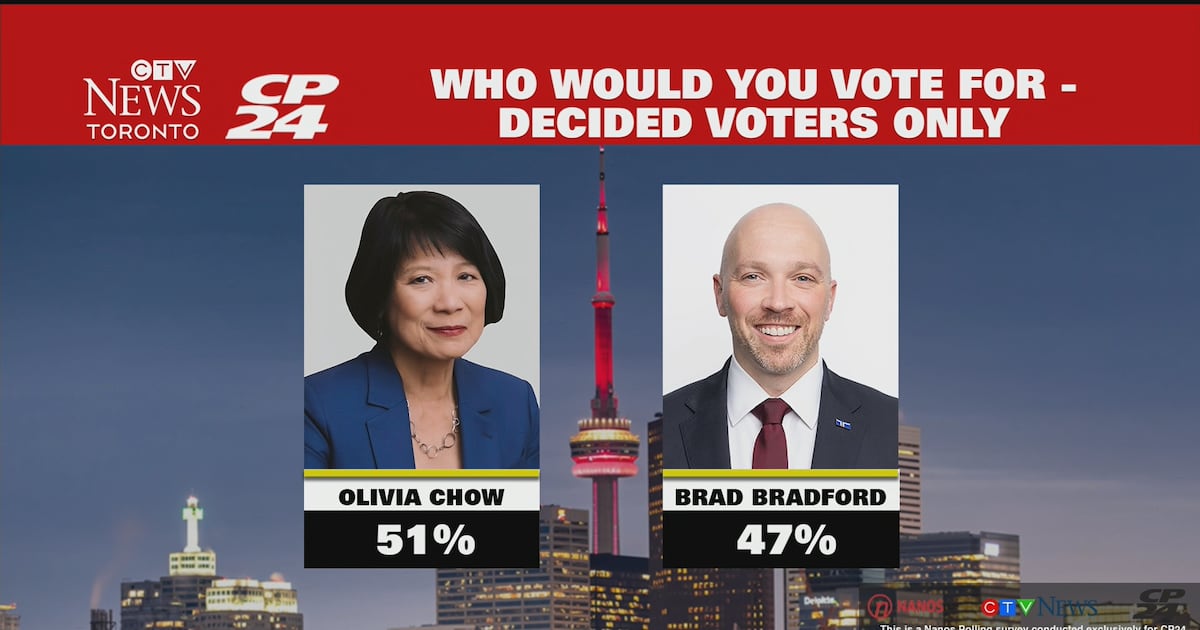
A Nanos poll of 757 Toronto residents, taken October 8 to 10, found Olivia Chow at 51 per cent and Brad Bradford at 47 per cent among decided voters. CTV News Toronto and CP24 published the results on October 13.
Among all respondents including those who said they were undecided, Chow had 43 per cent support, Bradford had 39 per cent, and 17 per cent said they had not decided. One per cent said they would vote for another candidate.
"Chow still leads, but Bradford has cut her cushion to 3.5 points among decided voters," Nanos founder and chief data scientist Nik Nanos said in his written analysis accompanying the poll, as reported by CTV News.
What the numbers show by area
CTV News reported the following breakdown from the poll:
In Toronto and East York, Chow leads Bradford 49 per cent to 30 per cent, with about 19 per cent undecided.
In North York, Bradford leads 45.6 per cent to Chow's 38.8 per cent, with about 15.6 per cent undecided.
In Scarborough, support is split nearly evenly, with over 14 per cent undecided.
In Etobicoke/York, Bradford has about 42.2 per cent to Chow's 39 per cent, with about 18 per cent undecided.
How this compares to the previous Nanos survey
CTV News reported that a Nanos poll published the previous week showed Chow up nearly 10 points over Bradford among decided voters. Nanos told CTV News the shift followed Chris Alexander's departure from the race, noting Alexander had around four per cent support in the earlier survey.
"Bradford has been picking up," Nanos said. "Scarborough tightening up, basically a dead heat, and Etobicoke/York basically a coin toss."
Poll methodology
The Nanos poll was conducted for CP24 and CTV News Toronto. Nanos surveyed 757 Toronto residents, randomly selected, between October 8 and 10, 2026, online and by telephone. The margin of error is plus or minus 3.6 percentage points, 19 times out of 20.
See published polls for the Toronto mayor race at /on/toronto-2026/polls. Election Day is Monday October 26, with polls open from 10 a.m. to 8 p.m.
Questions this story answers
What did the October 13 Nanos poll say about the Toronto mayor race?
CTV News Toronto reported on October 13 that a Nanos poll of 757 Toronto residents, taken October 8 to 10, found Olivia Chow at 51 per cent and Brad Bradford at 47 per cent among decided voters. Among all respondents including undecided voters, Chow had 43 per cent support, Bradford had 39 per cent, and 17 per cent said they were undecided. One per cent said they would vote for another candidate.
How has Brad Bradford's support changed compared to the previous Nanos poll?
CTV News reported that a previous Nanos poll, published last week, showed Chow up nearly 10 points over Bradford among decided voters. The October 8 to 10 survey reduced that gap to 3.5 points. CTV News and Nanos founder Nik Nanos linked the shift to Chris Alexander's departure from the race, noting Alexander had around four per cent support in the earlier Nanos poll.
What is Bradford's and Chow's support in different parts of Toronto?
According to the October 13 CTV News report on the Nanos poll, Chow leads strongly in Toronto and East York, at 49 per cent to Bradford's 30 per cent. Bradford leads in North York at 45.6 per cent to Chow's 38.8 per cent. Scarborough and Etobicoke/York are close to even, with large shares of undecided voters in both areas.
What is the margin of error in the Nanos poll?
The Nanos poll published October 13 by CTV News and CP24 has a margin of error of plus or minus 3.6 percentage points, 19 times out of 20. The survey covered 757 Toronto residents randomly selected, with interviews completed online and by telephone between October 8 and October 10, 2026.
How do women and men vote differently in this Toronto mayoral race?
The CTV News report on the October 13 Nanos poll found Chow's support among female respondents was 47.7 per cent, compared to 37.3 per cent among male respondents. Bradford's support among male respondents was 43.9 per cent, compared to 35.1 per cent among female respondents.
What does 17 per cent undecided mean for the Toronto mayor race?
With 17 per cent of respondents still undecided as of October 8 to 10, Nanos founder Nik Nanos told CTV News that both campaigns will have to seek votes across the city. The poll has a margin of error of plus or minus 3.6 percentage points, which means the gap of 3.5 points among decided voters is within that range. Election Day is October 26.
Where can I find published poll results for the Toronto mayor race?
Published polls for the Toronto 2026 mayor race are listed at /on/toronto-2026/polls. That page tracks surveys from multiple polling firms, with field dates, sample sizes, and methodologies for each. Election Day is October 26, 2026.
When is Election Day in Toronto's 2026 municipal election?
Election Day is Monday October 26, 2026. Polls are open from 10 a.m. to 8 p.m. Eligible voters must vote at their assigned voting place, shown on their Voter Information Card or at toronto.ca/Elections. The Toronto mayor race, 25 ward councillor races, and school board trustee races are all on the ballot that day.
Sources
The pages this story draws on. Open one to check a claim yourself.
Found an error? Tell the editors with the corrections form. A correction is noted on the story it changes. Read our standards.
Topics
More from voche.me

222,550 voters cast advance ballots in Toronto's 2026 election, a new record
Toronto advance voting ends today at 7 p.m.
