Toronto's advance voting was uneven by ward, polling firm finds
Eglinton-Lawrence had the highest share of electors vote early, at 16.7 per cent. Humber River-Black Creek had the lowest, at 5.1 per cent.
Reported. A news outlet found this. voche.me names the outlet and links its report. Read the original report on press.liaisonstrategies.ca.
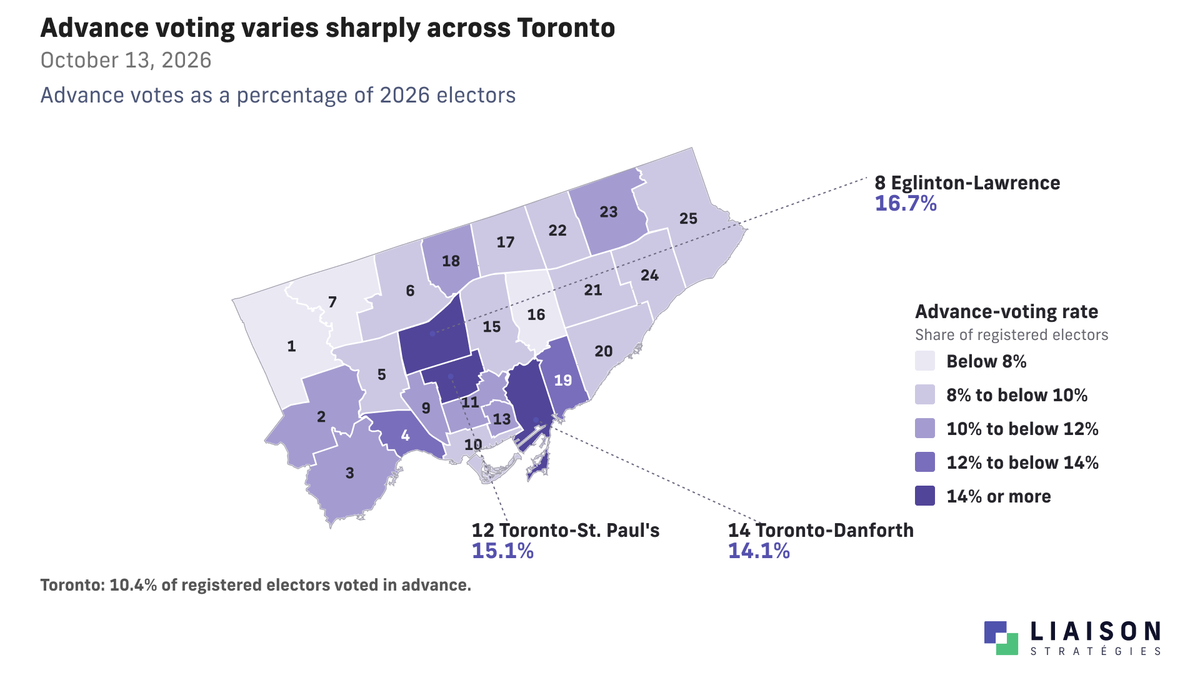
Toronto's record advance vote was not spread evenly across the city's 25 wards, according to a ward-level analysis published Tuesday by Liaison Strategies, a polling firm that has been conducting surveys during the mayoral campaign.
The city announced about 222,550 people cast early ballots between October 6 and 11. Liaison Strategies analyzed how those votes were distributed by ward and by the city's four broad regions.
Downtown accounted for 40.1 per cent of advance votes while holding 35.2 per cent of the electors on the city's voters list. North York supplied 27.8 per cent of early ballots and 29.8 per cent of electors. Scarborough had 19.1 per cent of advance votes and 21.3 per cent of electors. Etobicoke had 13.0 per cent of advance votes and 13.6 per cent of electors.
Ward differences were larger than regional ones
The differences within each region were more striking than the regional totals. Eglinton-Lawrence, a North York ward, had about 15,000 advance voters, which Liaison Strategies calculated at 16.7 per cent of its registered electors. That was the highest advance-voting rate in the city. Toronto-St. Paul's followed at 15.1 per cent, and Toronto-Danforth at 14.1 per cent.
At the other end, Humber River-Black Creek had the lowest rate in the city at 5.1 per cent. The firm noted that Eglinton-Lawrence's rate was more than three times as high. Within North York alone, the gap between those two wards was the largest in the city.
In Scarborough, Scarborough North led at 11.6 per cent, while Scarborough Centre was at 8.4 per cent.
How counts grew from 2023
Advance voting was up in all four regions compared to the 2023 mayoral by-election. North York's advance count grew by about 92 per cent. Etobicoke's was up about 73 per cent. Downtown's was up about 68 per cent. Scarborough's was up about 54 per cent. Liaison Strategies noted these figures do not account for growth in the number of registered electors.
David Valentin, a principal at the firm, wrote that downtown's share of the early vote has slipped from 41.0 per cent in 2023 to 40.1 per cent this year, while North York's share grew from 24.9 per cent to 27.8 per cent.
Advance voting is now closed. Voters who have not yet cast a ballot can do so on election day, October 26, when polls open at 10 a.m. and close at 8 p.m. Find your polling location on the Toronto election candidates page or through the City of Toronto's website.
Questions this story answers
What was Toronto's advance voting record in 2026?
The City of Toronto announced that 222,550 people cast advance ballots between October 6 and 11, 2026. Liaison Strategies, a polling firm, cited this figure in its ward-level analysis published October 13. The firm noted this is up about 72 per cent from 129,745 advance votes in the 2023 mayoral by-election, the figure listed in a separate City of Toronto release.
Which Toronto ward had the highest advance-voting rate?
Eglinton-Lawrence had the highest advance-voting rate in the city, according to Liaison Strategies' analysis. About 15,000 people voted early there, which represents 16.7 per cent of the ward's registered electors. That is the highest share of any ward in the city. Toronto-St. Paul's was second at 15.1 per cent, followed by Toronto-Danforth at 14.1 per cent.
Which Toronto ward had the lowest advance-voting rate?
Humber River-Black Creek had the lowest advance-voting rate in the city, at 5.1 per cent of its electors, according to Liaison Strategies. Eglinton-Lawrence's rate of 16.7 per cent is more than three times as high. Voters in Humber River-Black Creek who have not yet voted can still do so on election day, October 26.
How was advance voting distributed across Toronto's four regions?
Liaison Strategies divided the city into four regions. Downtown accounted for 40.1 per cent of advance votes and 35.2 per cent of electors. North York accounted for 27.8 per cent of advance votes and 29.8 per cent of electors. Scarborough had 19.1 per cent of advance votes and 21.3 per cent of electors. Etobicoke had 13.0 per cent of advance votes and 13.6 per cent of electors.
How did advance voting change from 2023 in each region?
Liaison Strategies calculated that all four regions had more advance votes than in 2023. North York's advance count grew by about 92 per cent. Etobicoke's was up about 73 per cent. Downtown's was up about 68 per cent. Scarborough's advance count grew by about 54 per cent. The firm notes these figures do not adjust for changes in the number of registered electors in each region.
What does this mean for the October 26 election?
Advance voting is now closed. Voters who did not cast an early ballot can still vote on election day, October 26, 2026. All 25 city wards and all school board trustee contests will appear on the ballot. Voters in wards with lower advance participation, such as Humber River-Black Creek and Scarborough Centre, have a large share of their fellow electors still to vote. The city's on-day polls open at 10 a.m. and close at 8 p.m.
Who conducted this analysis of Toronto's advance voting figures?
Liaison Strategies, a polling firm based in Toronto, published the ward-level analysis on October 13, 2026. David Valentin, a principal at the firm, wrote the report. Liaison Strategies has conducted polling for CP24 and CTV News Toronto during the 2026 mayoral campaign. The advance voting totals in the report come from the City of Toronto's own announcement.
Is downtown Toronto voting more than its share of the electorate?
Yes, according to Liaison Strategies' analysis. Downtown accounted for 40.1 per cent of advance votes but 35.2 per cent of the electors on the city's voters list. The firm notes that downtown's share of advance votes is lower than in 2023, when it was 41.0 per cent, while North York's share has grown from 24.9 per cent to 27.8 per cent.
When is election day in Toronto?
Election day in Toronto's 2026 municipal election is Monday, October 26, 2026. On-day polls are open from 10 a.m. to 8 p.m. Voters who did not vote in advance can find their polling location through the City of Toronto's website. The election covers the office of mayor, all 25 ward councillor seats, and school board trustee positions.
Sources
The pages this story draws on. Open one to check a claim yourself.
Found an error? Tell the editors with the corrections form. A correction is noted on the story it changes. Read our standards.
Topics
More from voche.me

222,550 voters cast advance ballots in Toronto's 2026 election, a new record
Toronto advance voting ends today at 7 p.m.
